How Are Georgia Milestone Assessment Scores Grouped for Reporting? + Free PLC Template
Understanding how Georgia Milestones Assessment System (GMAS) scores are grouped helps teachers, instructional coaches, school leaders, and district administrators make informed instructional decisions. These scores provide valuable insight into student mastery of the Georgia Standards of Excellence (GSE) and help schools identify where additional support or enrichment may be needed.
While Georgia Milestones results are an important part of statewide accountability, they also serve as a roadmap for instruction. By understanding what each performance level represents, educators can identify learning gaps, celebrate student growth, and develop targeted instructional plans.
What Are the Four GMAS Performance Levels?
Georgia Milestones scores fall into four distinct performance levels that describe a student’s level of mastery of the Georgia Standards of Excellence.
Beginning Learner
Students in this category have not yet demonstrated proficiency and require significant academic support to succeed in the next grade level or course. These students often benefit from instruction that strengthens prerequisite skills before moving into more rigorous grade-level content.
Instructional Focus
- Identify foundational skill gaps.
- Use formative assessments to pinpoint specific learning needs.
- Provide targeted small-group or individualized intervention.
- Monitor progress regularly and adjust instruction as students grow.
Goal: Close foundational learning gaps and build the skills students need for grade-level success.
Developing Learner
Students performing at the Developing Learner level demonstrate partial proficiency. They understand many grade-level concepts but may struggle to consistently apply their learning independently. Because these students are often close to reaching proficiency, targeted remediation and standards-aligned practice can help close learning gaps and build confidence.
Instructional Focus
- Prioritize standards that were close to mastery.
- Address misconceptions through targeted instruction.
- Provide scaffolded practice opportunities.
- Monitor progress to ensure continued growth.
Goal: Help students move from partial proficiency to consistent, independent application of grade-level skills.
Proficient Learner
Proficient Learners have demonstrated grade-level mastery and are prepared for the next academic step. They are considered on track for college and career readiness. Continued opportunities to apply learning in increasingly rigorous ways help reinforce understanding while supporting ongoing academic growth.
Instructional Focus
- Reinforce grade-level standards.
- Incorporate higher-order thinking and problem-solving activities.
- Continue progress monitoring throughout the year.
- Provide opportunities for application and deeper learning.
Goal: Maintain strong performance while continuing to deepen understanding.
Distinguished Learner
Students performing at the Distinguished Learner level exceed grade-level expectations and demonstrate advanced mastery of the Georgia Standards of Excellence. These students benefit from enrichment opportunities that extend learning beyond grade-level expectations and encourage deeper exploration.
Instructional Focus
- Provide enrichment and extension activities.
- Encourage inquiry-based learning and independent problem-solving.
- Incorporate complex, real-world applications.
- Continue challenging students with advanced learning opportunities.
Goal: Extend learning while maintaining engagement and academic challenge.
Georgia Milestones Performance Level Score Ranges by Subject and Grade
Below is a breakdown of scale score thresholds for each performance level across subjects and grade levels, along with estimated correct-answer ranges to help educators better understand what each performance level represents.
English Language Arts (ELA)
| Grade | Beginning Learner | Developing Learner | Proficient Learner | Distinguished Learner | Est. Correct Answers (out of ~55) |
| 3 | 180–474 | 475–524 | 525–580 | 581–830 | 0–27 / 28–35 / 36–45 / 46–55 |
| 4 | 210–474 | 475–524 | 525–573 | 574–775 | 0–27 / 28–35 / 36–45 / 46–55 |
| 5 | 210–474 | 475–524 | 525–586 | 587–760 | 0–27 / 28–35 / 36–45 / 46–55 |
| 6 | 140–474 | 475–524 | 525–598 | 599–820 | 0–27 / 28–35 / 36–45 / 46–55 |
| 7 | 165–474 | 475–524 | 525–591 | 592–785 | 0–27 / 28–35 / 36–45 / 46–55 |
| 8 | 225–474 | 475–524 | 525–580 | 581–730 | 0–27 / 28–35 / 36–45 / 46–55 |
Mathematics
| Grade | Beginning Learner | Developing Learner | Proficient Learner | Distinguished Learner | Est. Correct Answers (out of ~55) |
| 3 | 290–474 | 475–524 | 525–579 | 580–705 | 0–28 / 29–36 / 37–46 / 47–58 |
| 4 | 270–474 | 475–524 | 525–584 | 585–715 | 0–28 / 29–36 / 37–46 / 47–58 |
| 5 | 265–474 | 475–524 | 525–579 | 580–725 | 0–28 / 29–36 / 37–46 / 47–58 |
| 6 | 285–474 | 475–524 | 525–579 | 580–700 | 0–28 / 29–36 / 37–46 / 47–58 |
| 7 | 265–474 | 475–524 | 525–579 | 580–740 | 0–28 / 29–36 / 37–46 / 47–58 |
| 8 | 275–474 | 475–524 | 525–578 | 579–755 | 0–28 / 29–36 / 37–46 / 47–58 |
Science (Grades 5 and 8)
| Grade | Beginning Learner | Developing Learner | Proficient Learner | Distinguished Learner | Est. Correct Answers (out of ~55) |
| 5 | 160–474 | 475–524 | 525–594 | 595–780 | 0–27 / 28–35 / 36–45 / 46–55 |
| 8 | 165–474 | 475–524 | 525–592 | 593–785 | 0–27 / 28–35 / 36–45 / 46–55 |
Social Studies (Grade 8)
| Grade | Beginning Learner | Developing Learner | Proficient Learner | Distinguished Learner | Est. Correct Answers (out of ~55) |
| 8 | 240–474 | 475–524 | 525–571 | 572–715 | 0–27 / 28–35 / 36–45 / 46–55 |
Note: The estimated number of correct answers is based on approximate total items per test and general performance level thresholds. Actual scoring may vary depending on test form and specific item weighting.
Key Takeaway: Performance levels provide a valuable snapshot of student achievement, but they are most meaningful when combined with classroom observations, formative assessment data, and standards-level analysis to guide instruction.
Supporting Georgia’s Increased Focus on Writing
One of the biggest instructional shifts in Georgia Milestones in the past school year was writing. As schools adjusted to expanded writing expectations across content areas, many educators looked for additional resources that provide meaningful writing practice and help students build confidence with constructed-response questions.
A Georgia-Based Partnership
Progress Learning’s story began in Georgia classrooms under the name USATestprep in 1998. To further support Georgia educators, we recently integrated Lennections’ content into our platform. A trusted resource for assessments across Georgia classrooms, Lennections has long been known for its standards aligned “Assesslets” and its focus on preparing students for the rigor of the Georgia Milestones.
What’s New
Beginning next school year, content previously found in Lennections “Assesslets” will be available through the Progress Learning platform, giving schools access to the same Georgia-specific content they trust, along with:
- Expanded resources across all four core subjects.
- Personalized learning paths and practice.
- Enhanced reporting and data tools.
- Gamified activities that increase student engagement.
By incorporating regular writing practice throughout the year, schools can better prepare students for the writing expectations they’ll encounter on the Georgia Milestones.
Using Georgia Milestones Data in PLCs
Professional Learning Communities (PLCs) help educators turn assessment data into instructional action. During PLC meetings, teams can:
- Review performance trends across classrooms and grade levels.
- Identify students who moved between performance levels.
- Analyze strengths and areas for improvement within the Georgia Standards of Excellence.
- Develop intervention and enrichment strategies.
- Establish measurable student growth goals.
- Monitor progress throughout the school year.
Ready to put your assessment data into action? Download our free Georgia PLC Data Analysis Template to help your team organize assessment results, document instructional decisions, and plan next steps.
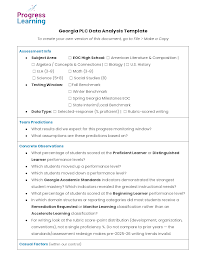 The template helps schools and districts:
- Organize assessment data.
- Identify priority standards.
- Facilitate productive PLC conversations.
- Develop intervention and enrichment plans.
- Establish student growth goals.
- Track progress throughout the school year.
After opening the template, select File > Make a Copy to customize it for your school, grade level, or PLC team.
Looking Beyond Proficiency
Performance levels provide a snapshot of student achievement, but they tell only part of the story.
Students who move from Beginning Learner to Developing Learner, or from Developing Learner to Proficient Learner, have made meaningful academic progress even if they have not yet reached the Distinguished Learner level. Recognizing growth alongside proficiency gives educators a more complete picture of student success.
Georgia Milestones results provide valuable information, but their greatest impact comes from how educators respond to the data. By combining assessment results with ongoing formative assessment, writing instruction, progress monitoring, and collaborative PLC conversations, schools can create a continuous cycle of instructional improvement that supports every student’s path toward success.