North Carolina EOG & EOC Achievement Levels Explained + Free PLC Template
Each year, North Carolina students participate in End-of-Grade (EOG) and End-of-Course (EOC) assessments to measure their mastery of the North Carolina Standard Course of Study (NCSCS). While these assessments play an important role in statewide accountability, they also provide valuable insight into student learning that can inform instruction throughout the school year.
For teachers, instructional coaches, school leaders, and district administrators, understanding Achievement Levels can help identify learning gaps, prioritize instructional support, and strengthen Professional Learning Community (PLC) conversations. When used thoughtfully, assessment data becomes more than a year-end report. It becomes a roadmap for supporting student growth.
Overview of North Carolina EOG and EOC Achievement Levels
North Carolina uses four Achievement Levels to describe student performance on its EOG and EOC assessments: Not Proficient, Level 3, Level 4, and Level 5. Rather than simply reporting a test score, these Achievement Levels help educators understand how well students have mastered the NCSCS and where additional instructional support or enrichment may be needed.
The same Achievement Levels are used across North Carolina’s statewide assessment program, including:
End-of-Grade (EOG) Assessments
- Reading (Grades 3–8)
- Mathematics (Grades 3–8)
- Science (Grades 5 and 8)
End-of-Course (EOC) Assessments
- NC Math 1
- NC Math 3
- Biology
- English II
Although each assessment measures different content, the Achievement Levels have a consistent purpose across subjects and grade levels. They provide educators with a shared framework for understanding student performance, identifying priority standards, and planning targeted instruction to support continued growth.
The Four Achievement Levels: What They Mean for Your School
Each Achievement Level provides valuable insight into where students are in their learning journey and what instructional support may help them continue progressing.
Not Proficient
Students identified as Not Proficient have not yet demonstrated consistent mastery of grade-level expectations. They often need additional support with foundational skills and prerequisite concepts before they can successfully engage with grade-level instruction independently.
Instructional Focus
- Identify prerequisite skills that require reinforcement.
- Use diagnostic and formative assessment data to pinpoint specific learning gaps.
- Provide intensive small-group or individualized intervention.
- Monitor progress regularly to determine instructional effectiveness.
- Build student confidence alongside academic skills.
Goal: Close foundational learning gaps so students can successfully engage with grade-level instruction.
Level 3
Students performing at Level 3 demonstrate a basic understanding of grade-level standards. While they have met the state’s proficiency benchmark, they may still benefit from targeted support to strengthen independent application of skills and prepare for more rigorous coursework. For many schools, this group represents an important opportunity to accelerate growth through Tier 2 intervention and targeted instructional support.
Instructional Focus
- Provide targeted small-group instruction focused on priority standards.
- Use standards-level data to identify unfinished learning.
- Incorporate scaffolded instruction while gradually increasing student independence.
- Regularly review assessment data to adjust intervention groups.
- Reinforce foundational concepts while introducing more rigorous application opportunities.
Goal: Help students build confidence and consistency so they can independently apply grade-level skills.
Level 4
Students at Level 4 demonstrate a strong understanding of grade-level content and consistently apply knowledge and skills independently. These students are generally on track for future academic success and are well prepared for increasingly rigorous coursework.
Instructional Focus
- Maintain rigorous Tier 1 instruction aligned to the North Carolina Standard Course of Study.
- Provide opportunities for deeper analysis and problem solving.
- Incorporate standards-aligned enrichment activities.
- Use formative assessments to monitor continued growth.
- Encourage students to explain reasoning and defend their thinking using evidence.
Goal: Maintain high levels of achievement while continuing to deepen understanding.
Level 5
Students performing at Level 5 demonstrate advanced mastery of grade-level expectations. They consistently apply higher-order thinking skills, solve complex problems, and are ready for additional academic challenges.
Instructional Focus
- Increase instructional rigor and complexity.
- Provide enrichment opportunities that extend beyond grade-level expectations.
- Encourage independent research, inquiry, and real-world applications.
- Support advanced learning opportunities, including honors, Advanced Placement, or dual-enrollment pathways when appropriate.
- Continue challenging students through higher Depth of Knowledge (DOK) tasks.
Goal: Sustain high levels of engagement while preparing students for advanced academic opportunities.
From Test Scores to Classroom Action: A Simple 3-Step Process
Assessment data is most valuable when it leads to instructional decisions. Rather than focusing only on proficiency percentages, schools can use a structured process to translate EOG and EOC results into meaningful next steps.
Step 1: Spot the Big Trends
Begin by reviewing school-wide and grade-level performance before analyzing individual student data. Looking at the broader picture helps school leaders prioritize resources and instructional support where they are needed most.
Questions to consider:
- Which grade levels demonstrated the strongest performance?
- Which content areas require additional instructional support?
- Are there trends across classrooms or schools?
- Which student groups may need additional attention?
Step 2: Zoom In on Specific Standards
After identifying school-wide trends, review standards-level performance data to pinpoint the concepts that had the greatest impact on student achievement. Focusing on specific standards helps instructional teams make the most of intervention time and prioritize the skills that will have the greatest impact on future learning.
Questions to guide your review include:
- Which standards had the lowest levels of mastery?
- Are there concepts that appear across multiple grade levels?
- Which standards should be prioritized during the first instructional unit of the new school year?
- Which concepts will have the greatest impact if addressed early?
Step 3: Turn Data Into Action Through PLCs
Professional Learning Communities (PLCs) provide an opportunity for educators to collaboratively analyze assessment results and develop instructional plans.
Effective PLC conversations often include:
- Identifying priority standards.
- Reviewing instructional practices.
- Creating flexible intervention groups.
- Planning enrichment opportunities.
- Establishing measurable student growth goals.
- Monitoring progress throughout the school year.
Helpful PLC questions include:
- Which standards showed the strongest performance?
- Which standards should be prioritized first?
- Which students need intervention?
- Which students are ready for enrichment?
- What instructional practices contributed to student success?
When teams consistently use assessment data to guide instruction, PLC conversations become more focused, collaborative, and actionable. Download our Free North Carolina PLC Data Analysis Template to start your effective PLC conversations and turn insight into action.
Where Progress Learning Fits
Understanding Achievement Levels is only the first step. Progress Learning supports North Carolina schools and districts by helping educators connect assessment data with targeted instruction, intervention, and progress monitoring that supports student growth throughout the school year.
Assessments Designed for the North Carolina Standard Course of Study
With a library of more than 200,000 teacher-written assessment items aligned to North Carolina standards, educators can build custom assessments or choose from pre-built assessments. These tools make it easy to evaluate student learning, identify standards-level gaps, and monitor progress throughout the year.
Schools use these assessments to:
- Identify standards-level strengths and learning gaps.
- Build benchmark assessments that reflect the rigor and format of North Carolina EOG and EOC assessments.
- Monitor student progress throughout the year.
- Gather actionable data to identify learning gaps and inform instruction.
- Use detailed reports to support PLC conversations and instructional planning.
Adaptive Intervention for Foundational Learning
For students who need additional support, Liftoff provides adaptive intervention for grades 2–8. Using diagnostic data or imported NWEA MAP scores, Liftoff identifies prerequisite skill gaps and automatically builds individualized learning paths aligned to each student’s needs. This helps schools expand intervention efforts while giving teachers more time to focus on instruction.
Get the North Carolina EOG/EOC PLC Data Analysis Template
Ready to put your assessment data into action? Download our free North Carolina EOG/EOC PLC Data Analysis Template to organize assessment results, identify priority standards, document instructional responses, and plan next steps for student growth.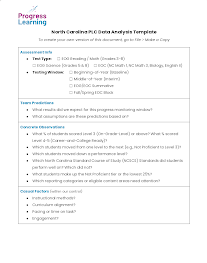
The template helps schools and districts:
- Organize assessment data.
- Identify instructional priorities.
- Document team decisions.
- Plan intervention and enrichment.
- Monitor student growth over time.
Whether you’re planning summer professional development, preparing for the new school year, or conducting ongoing data reviews, the template provides a practical framework for turning assessment results into instructional action.
After opening the template, select File > Make a Copy to customize it for your school, grade level, or PLC team.
North Carolina EOG and EOC results provide valuable insight into student learning, but their greatest impact comes from how educators use them. By identifying priority standards, collaborating through PLCs, and using assessment data to guide instruction, schools can create meaningful opportunities for growth for every student.