Florida FAST PM 1-3 Scores: A Guide for Student Growth + PLC Template
Florida FAST Scores Are More Than a Number
Every testing window brings the same question: Now what?
Whether reviewing PM1 baseline results, PM2 midyear growth data, or PM3 end-of-year outcomes, educators across Florida are tasked with turning assessment results into meaningful instructional decisions.
That can be easier said than done.
Florida’s FAST assessment system provides schools with a wealth of information, but data only becomes valuable when it helps answer important questions:
- Which students are on track?
- Which students need additional support?
- Which Florida B.E.S.T. Standards require reteaching?
- Which instructional practices are producing growth?
- Where should intervention resources be focused?
Understanding Florida FAST PM 1-3 scores is the first step. Knowing how to respond to them is what drives student growth.
The Five Florida Achievement Levels: What They Mean for Your District
Florida uses a consistent five-level achievement scale across FAST assessments and many statewide assessments. While the scale remains the same, the instructional response should look different at each level.
Level 1: Inadequate (Well Below Grade Level)
Students performing at Level 1 demonstrate significant gaps in grade-level understanding and often require intensive support to access current content successfully. These students are at the highest risk for future academic struggles if interventions are not implemented quickly.
Instructional priorities include:
- Intensive Tier 3 intervention
- Foundational skill development
- Frequent progress monitoring
- Small-group or individualized support
- Targeted remediation focused on prerequisite skills
Level 2: Below Satisfactory (Below Grade Level)
Students at Level 2 typically understand portions of the content but struggle to apply skills independently or consistently. This group often becomes a primary focus of Tier 2 intervention efforts.
Instructional priorities include:
- Small-group remediation
- Scaffolded instruction
- Targeted practice on specific Florida B.E.S.T. Standards
- Frequent review of progress-monitoring data
- Flexible intervention grouping
Level 3: On Grade Level
Level 3 represents on-grade-level performance and serves as an important benchmark across Florida’s assessment system. While these students are meeting expectations, they still require continued support and rigorous instruction to maintain growth.
Instructional priorities include:
- Strong Tier 1 instruction
- Ongoing formative assessment
- Continued exposure to grade-level rigor
- Standards-aligned extension activities
- Routine monitoring to prevent regression
Level 4: Proficient
Students performing at Level 4 consistently demonstrate a strong understanding of grade-level content and are generally well positioned for future academic success.
Instructional priorities include:
- Higher-level application tasks
- Increased rigor and complexity
- Advanced problem-solving opportunities
- Ongoing review of reporting category performance
Level 5: Mastery
Students at Level 5 demonstrate an in-depth understanding of content and are often ready for advanced learning opportunities. These students still need intentional support to remain challenged and engaged.
Instructional priorities include:
- Enrichment opportunities
- Advanced coursework pathways
- High Depth of Knowledge (DOK) tasks
- Independent research and inquiry
- Advanced writing and problem-solving experiences
From Test Scores to Classroom Action: A Simple 3-Step Process
Assessment results are only valuable when they lead to instructional action. One of the most effective ways to approach FAST data is through a structured three-step review process that moves from broad trends to classroom-level decisions.
Step 1: Spot the Big Trends
Before examining individual students, identify patterns across grade levels, content areas, and classrooms.
Ask questions such as:
- Which grade levels showed the strongest growth?
- Where did performance remain stagnant?
- Are challenges isolated to a single classroom or recurring across multiple teams?
- Which student groups demonstrated the greatest gains?
This initial review helps school leaders identify larger instructional trends before focusing on individual standards or students.
Step 2: Zoom In on Specific Skills
Students rarely struggle with an entire subject area. More often, challenges emerge within specific reporting categories or standards. Instead of reteaching everything, focus on identifying the exact skills contributing to lower performance.
Consider questions such as:
- Which Florida B.E.S.T. standards need reteaching?
- Which reporting categories consistently underperformed?
- Are weaknesses isolated to a specific benchmark?
- Which standards improved between monitoring windows?
This targeted approach helps maximize instructional time and intervention resources.
Step 3: Map Out the Strategy Through PLCs
This is where data becomes instruction. Professional Learning Communities (PLCs) create a structured opportunity for educators to analyze results, identify root causes, and determine next steps.
Effective PLC conversations often focus on questions such as:
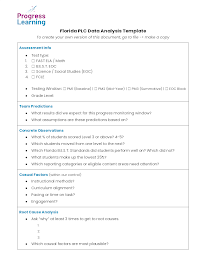
- What percentage of students scored at Level 3 or above?
- Which students moved from one achievement level to the next?
- Which students narrowly missed proficiency?
- Which instructional practices contributed to gains?
- Which interventions were most effective for the lowest-performing students?
- Which benchmarks require immediate attention?
To support these conversations, schools can use a structured data-analysis process that documents observations, identifies root causes, and establishes clear action steps. Florida educators can use a PLC data-analysis template to guide those discussions and create consistency across grade levels and content areas.
Making FAST Data Meaningful
One of the most common mistakes schools make is treating FAST results as a compliance task rather than a tool for continuous improvement.
The goal is not simply to review scores. It is to uncover where students are thriving, where they are struggling, and what support will help them grow. Effective data conversations move beyond asking, “How did we do?” and instead focus on, “What do students need next?” That shift transforms assessment results from static data points into a roadmap for action.
Rather than viewing FAST data as a snapshot, schools can use PM1, PM2, and PM3 results to establish an ongoing cycle of analysis, intervention, and progress monitoring that supports student growth throughout the year.
How Progress Learning Supports Florida Schools
Once schools identify learning gaps, the next challenge becomes providing targeted support.
Progress Learning helps Florida schools support intervention, remediation, progress monitoring, and assessment efforts aligned to the Florida B.E.S.T. Standards.
Schools use Progress Learning to:
- Create custom assessments that mirror the rigor and format of FAST assessments
- Monitor student growth throughout the year
- Deliver standards-aligned intervention and remediation
- Identify specific skill gaps through reporting and diagnostics
- Generate individualized learning pathways through Liftoff for grades 2-8
Download the Free Florida PLC Data Analysis Template
Successful schools don’t stop at reviewing data. They build systems that help teams consistently act on it.
Our free Florida PLC Data Analysis Template helps educators:
- Organize FAST PM1, PM2, and PM3 results
- Identify trends across achievement levels
- Analyze Florida B.E.S.T. Standards performance
- Conduct root-cause analysis
- Develop actionable instructional plans
- Monitor progress over time
Be sure to click “File” > “Make a copy” to customize it for your PLC. When data conversations become structured and intentional, assessment results become far more than numbers. They become a roadmap for student growth.