How Ruskin High School Uses Progress Learning to Turn Data Into Student Progress
School Overview
Location: Kansas City, Missouri
School Size: Approximately 1,200–1,300 students
School Profile: Ruskin High School is the only high school in Hickman Mills C-1 School District. The school serves a diverse student population, with more than 20 languages spoken across the district. Ruskin has focused on improving student performance on Missouri End-of-Course assessments through consistent progress monitoring, standards-aligned practice, and data-driven instruction.
Teaching Where Her Roots Are
Kimberly Sixta’s connection to Hickman Mills C-1 runs deep. She grew up in the district, attended its schools, and returned to build her career there. Twenty-eight years later, Sixta teaches American Government and other social studies courses to students in grades 10–12 at Ruskin High School, including the children of former classmates.
In 2025, that commitment to her students and community earned Sixta statewide recognition when she was named Missouri’s 2026 Teacher of the Year. She became the 57th Missouri educator to receive the honor.
In the classroom, Sixta is focused on helping students build the knowledge, skills, and confidence they need to succeed. Progress Learning has become part of that approach, helping her establish student baselines, monitor growth throughout the year, identify areas for reteaching, and prepare students for Missouri’s Government EOC.
And the results show a positive trajectory.
A Clear Pattern of Government EOC Growth
Improving Government EOC performance has been a long-term focus at Ruskin High School.
Hickman Mills began using Progress Learning around 2011–12, when the district was navigating a high school merger and the implementation of EOC testing. For Government, the goal was clear: help students master the Missouri Learning Standards while strengthening their preparation for the state assessment.
That focus continues today, and recent Government EOC results show consistent year-over-year improvement.
Ruskin High School Government EOC Results
| Proficient/Advanced Performance Trends Updated October 2024 | progresslearning.com |
|
|---|---|
| School Year | Proficient/Advanced |
| 2022-23 | 17.2% |
| 2023-24 | 23.8% |
| 2024-25 | 24.8% |
| 2025-26 | Pending |
Source: Missouri Department of Elementary and Secondary Education (DESE). Spring 2026 Government EOC results will be added when public school-level data becomes available.
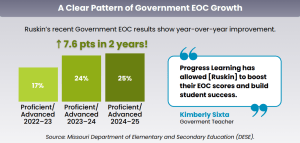
From 2022–23 to 2024–25, the percentage of Ruskin students reaching Proficient or Advanced on the Government EOC increased from 17.2% to 24.8%, a gain of 7.6 percentage points in two years. Proficiency increased each year during that period.
That progress reflects what Sixta has seen with her students. When asked to rate her experience with Progress Learning, she gave the platform a 10, explaining that “Progress Learning has allowed [Ruskin] to boost their EOC scores and build student success.”
Sixta has also seen students continue to make progress as Missouri’s EOC has evolved to include new question types. The results reflect an approach that begins long before students sit down for the state test.
Starting With a Baseline and Expecting Growth
For Sixta, EOC preparation starts at the beginning of the school year. She uses Progress Learning to establish a baseline for her students and then assesses them monthly to monitor their progress. Students are expected to demonstrate growth from one month to the next.
Rather than waiting until the Government EOC to find out how they are doing, students have regular opportunities to see what they have mastered and where they still need support. The process creates a straightforward instructional cycle:
Establish a Baseline → Assess → Analyze → Reteach → Practice → Measure Growth
Sixta also assigns Progress Learning practice during school breaks, allows multiple attempts, reviews answers with students, and uses item analysis to strengthen test-taking strategies.
The goal is not simply to complete more questions. Students have opportunities to understand why an answer is right or wrong, learn from mistakes, and strengthen the skills they will need when they encounter similar content again.
Turning Data Into the Next Lesson
Progress Learning gives Sixta something essential to her instructional approach: usable data.
She reviews assessment results to identify where students are struggling and where patterns are emerging across the class. When the data shows that students need additional support with a particular Missouri Learning Standard, she uses that information to guide reteaching. When it comes to making instructional decisions, Sixta is clear about the role of student results, explaining that “everything is data-driven instruction.”
Progress Learning reporting also helps her document student performance and use those results to guide instruction. Sixta and her colleagues can create and share common assessments, helping the team build a more consistent picture of what students know and where they need additional support.
Assessment becomes more than a score. It helps inform what comes next.
Making the EOC Feel Familiar
Data is only one part of Sixta’s approach. She also wants students to feel prepared for the experience of taking the Government EOC. That means knowing the content, but it also means understanding the types of questions they may encounter, working effectively with sources, and knowing how to approach a challenging item.
Sixta uses Progress Learning to give students repeated practice with content aligned to the Missouri Learning Standards and questions that reflect the EOC experience. She also works through questions strategically with students, helping them determine what a question is asking, evaluate answer choices, and develop stronger test-taking skills.
That practice has been particularly useful with primary sources, an area where Sixta had seen students struggle. With Progress Learning, students can practice interacting with primary-source questions while continuing to build their understanding of the Missouri Learning Standards.
Sixta has also seen students become more confident after practicing with the types of questions and tools they will encounter on the EOC. For her, that familiarity is an important part of preparing students for the assessment, which is why she says, “If you really want something that creates a mirror, use Progress Learning.”
Growth Through Practice, Feedback, and Another Try
Sixta’s approach gives students repeated opportunities to practice, learn from feedback, and try again. Assessment is not simply a measure of what students know at one point in time. It helps her determine what students need next.
That creates a continuous feedback loop throughout the year: Students practice. Sixta measures. The data reveals a gap. She reteaches. Students try again. This approach gives students time to build their understanding rather than expecting mastery all at once. They can revisit challenging concepts, learn from mistakes, and demonstrate what they have learned.
Ruskin’s Government EOC results demonstrate that growth over time. Proficiency increased from 17.2% in 2022–23 to 23.8% in 2023–24 and 24.8% in 2024–25, showing improvement in each of the past two school years.
More Than a Test Score
For all the focus on EOC growth, Sixta’s classroom is about more than preparing students for one assessment. Her Teacher of the Year profile highlights a classroom centered on civic engagement, meaningful learning experiences, and helping students develop their own voices. Some of her most meaningful accomplishments come when former students return to tell her she helped them believe in themselves or develop the confidence to speak up.
That perspective fits naturally with the way she approaches assessment. EOC scores matter, but regular assessment also gives students opportunities to see their progress, learn from mistakes, and keep working toward mastery. For a teacher who has spent 28 years serving the community that raised her, success is not simply about preparing students for a test. It is about helping them become more confident learners.
Building Success One Measure at a Time
After 28 years in Hickman Mills, Sixta knows that preparation and confidence go hand in hand.
Progress Learning helps her establish a baseline, monitor progress on the Missouri Learning Standards, identify areas for reteaching, and provide repeated EOC practice throughout the year. It is an approach that has contributed to what Sixta describes as “steady growth since implementing” Progress Learning.
For Missouri’s 2026 Teacher of the Year, the work is bigger than any single score. It is about helping students see their progress, understand what they need next, and build the confidence to keep moving forward.
At Ruskin, that means using data not simply to measure learning, but to guide it.